
What Is STEM at Peak?
Curious children become capable builders.
Curious Children Become Capable Builders
STEM is not four separate subjects. It is an active habit of mind: ask a question, build a model to test it, and discover what works. STEM stands for science, technology, engineering, and math, and at Peak, children begin using all four together on day one of kindergarten.
Young children are natural scientists. They ask why, take things apart, and test what happens. While many programs delay hands-on STEM until middle or high school, Peak builds on that natural curiosity from the very first day.
What STEM Looks Like in Early Childhood
Early STEM education does not mean hours in front of screens or rote worksheets. It means guided investigation, concrete tools, and structured discovery.
| Focus Area | What It Means | What Children Do at Peak |
|---|---|---|
| Science | Asking questions about God's creation | Plant seeds, observe weather patterns, sort rocks and leaves, and predict what happens next |
| Technology | Using tools to solve practical problems | Use simple physical tools, explore how parts interact, and discover how things are made |
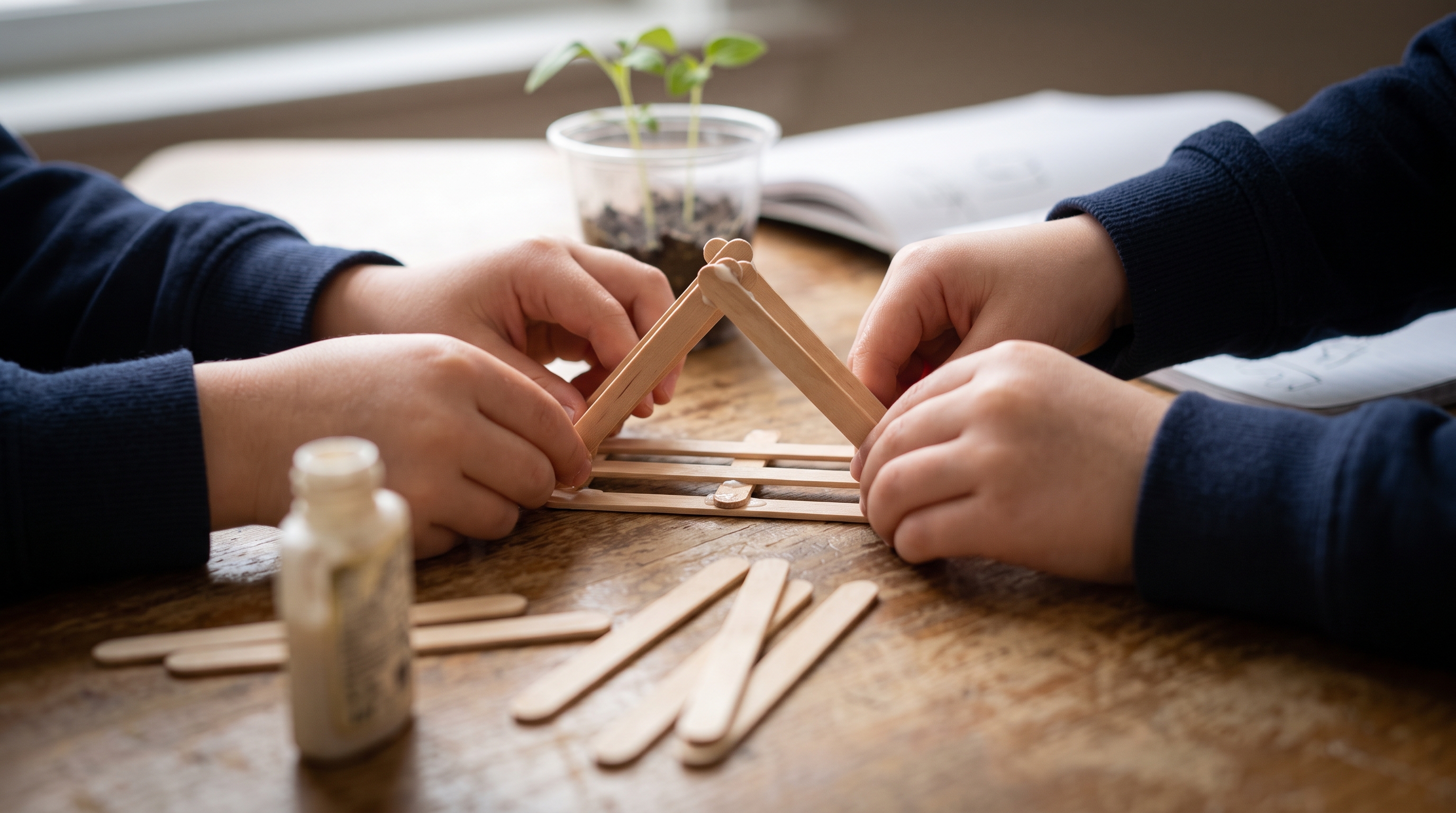
| Engineering | Designing and building solutions | Construct towers and bridges from blocks, test load limits, and rebuild to make them stronger |
| Math | Counting, measuring, and reasoning | Measure garden beds, count project materials, sort by size, and compare dimensions while building |
The Engineering Design Process
Professional engineers follow a disciplined cycle, and Peak students learn this same rhythm rather than simply following static directions:
- 1.Ask: What problem are we trying to solve?
- 2.Imagine: What are some possible ideas?
- 3.Plan: Draw the idea and pick the materials.
- 4.Create: Build a hands-on prototype.
- 5.Test: See how well it works.
- 6.Improve: Notice what happened, adjust the design, and test again.
In kindergarten, that might mean building a block bridge to support a toy car. If the structure tumbles, our classrooms do not treat it as a failure or a mistake on a worksheet. Teachers guide children to analyze what happened, reinforcing our core principle: a failed prototype is not a mistake; it is valuable data pointing toward the solution.
Computational Thinking
Computational thinking is the ability to solve complex problems step by step, and young children do not need computer screens or passive software to practice it. Through everyday, hands-on activities, they learn to:
- •Break it down: Divide a larger activity, like assembling a block tower or prepping a garden bed, into clear, manageable steps.
- •Spot patterns: Sort leaves by shape, group seeds by size, and recognize symmetry in the physical world.
- •Focus on what matters: Identify key details, such as which block placements create a steady base and which ones cause balance issues.
- •Give clear steps: Communicate directions to a classmate, step by step, to build matching structures without guessing.
Where Math Comes to Life
Math at Peak goes beyond memorization. Children measure the garden bed, count the seeds, and plan what supplies they need. When children use math to build something real, it makes sense, and they develop confidence rather than math anxiety.
Why Start in Kindergarten
- •Early Confidence: Children who enjoy math and science in the early years carry that attitude forward.
- •Habits That Last: Asking questions, trying again, and finishing a task build focus and persistence that help in every subject.
- •Real-World Career Awareness: Children meet engineers, builders, and business owners from our community, starting young.
- •Small Classes: With about 15 students per class, teachers know each child and can guide their curiosity.
STEM and Faith Belong Together
We believe the order we find in math and science comes from the Creator. Investigating the natural world is not in conflict with faith; it is a way of understanding His work.
“It is the glory of God to conceal a thing: but the honour of kings is to search out a matter.”
At Peak, we teach with a biblical worldview, so children see God's order and truth in His creation. When a child measures a seed, builds a bridge, or watches a plant grow, they are learning how God made the world work.
“The works of the LORD are great, sought out of all them that have pleasure therein.”
Our students are not trained merely to collect facts or pass standardized tests. They are taught to be thoughtful, honest builders who use what they learn to serve others and honor God.
Want to see STEM at Peak?
Join the founding family interest list and be the first to hear as we prepare to open in Fall 2028.
Keep exploring