
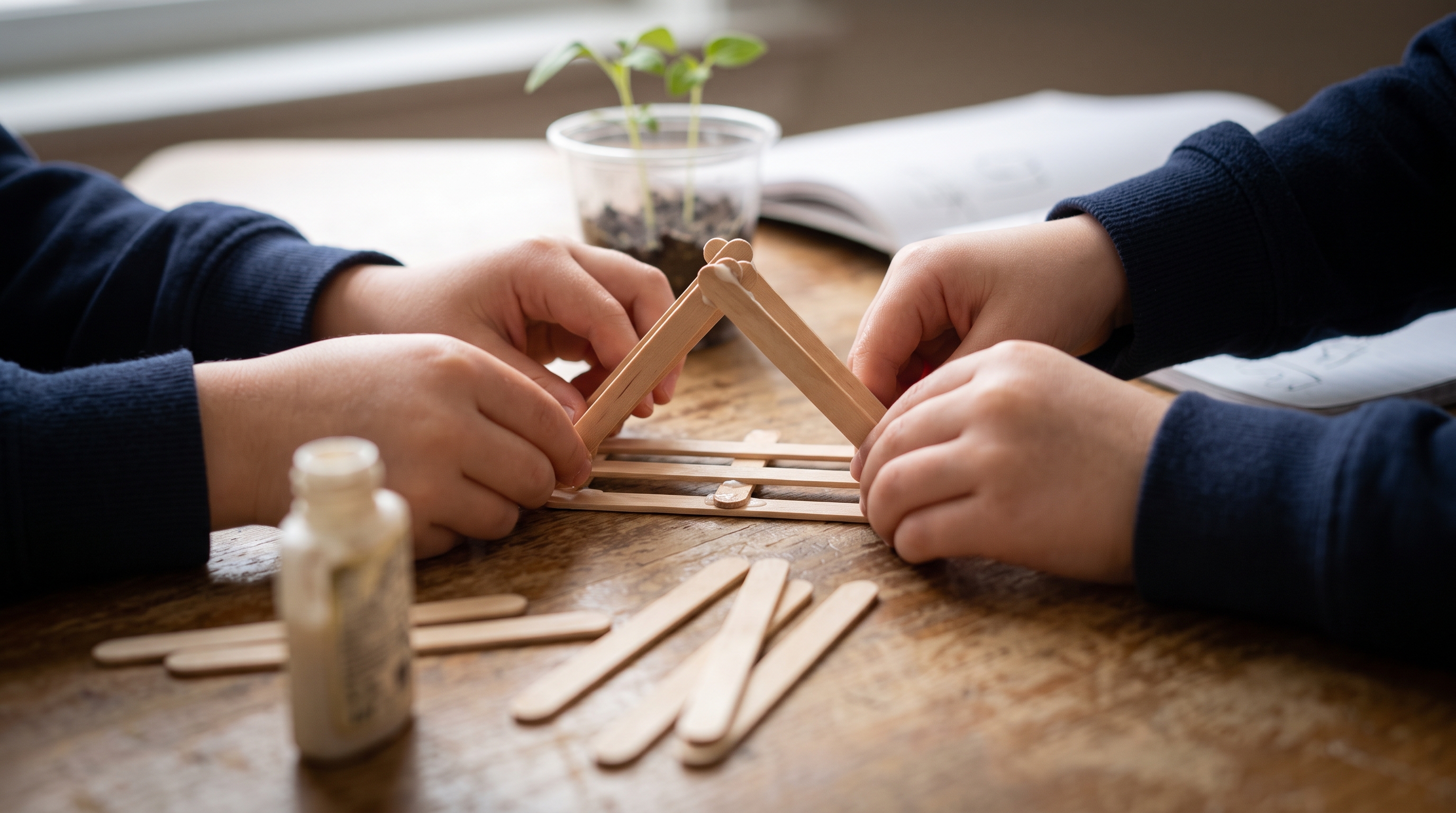
What Is Project-Based Learning?
Learning by doing, for God's glory.
Learning by Doing, for God's Glory
Project-based learning (PBL) gives academic knowledge an immediate, purposeful mission. Alongside direct teaching, practice, and assessment, children investigate real challenges over several days and put what they learn to work.
At Peak, every project begins with a challenge that sparks the need to know, prompting children to seek out math, science, and reading because the mission demands it. Every project ends with students using what they have built to serve our community, showing that all truth belongs to God and that knowledge is given to bless others.
How It Works: The 7 Elements of Every Peak Project
A high-quality project is never a quick craft or a one-day activity. Every project at Peak is built on seven intentional design elements:
- 1.A Challenging Problem or Driving Question: Children begin with an open-ended question worth answering, not a fill-in-the-blank worksheet.
- 2.Sustained Inquiry: Over several days, students ask questions, research answers, test ideas, and gather real evidence.
- 3.Authenticity: Challenges mirror real needs, using real tools to make a difference for families, neighbors, and our city.
- 4.Student Voice and Choice: Guided by educators, children make meaningful decisions about their designs, prototypes, and presentations.
- 5.Reflection: Students think about what they are discovering, where their ideas hit obstacles, and how God's truth guides their thinking.
- 6.Critique and Revision: Teams share drafts and prototypes, give and receive honest feedback, and refine their work.
- 7.A Public Product: Children present their finished solutions to a genuine audience, including parents, church members, and community leaders.
The L.E.A.D. Framework
L.E.A.D. is our guiding framework for teaching, and projects are where it comes alive every day. Project-based learning is also the first pillar of the Peak STEM Model: STEM-Focused, Project-Based Learning.
- •L: Learning Leads to Action. Projects begin with real needs that call for purposeful solutions.
- •E: Engage in Inquiry. Students ask bold questions, test physical models, and explore God's world firsthand.
- •A: Act as Leaders. Children collaborate in teams, share responsibility, and take ownership of their ideas.
- •D: Deliver to Community. Every project ends in service, with solutions that help others.
A Sample Week in Kindergarten
Project: A Garden for Our Neighbors
This is an example of how a project might run. It is not a fixed schedule.
| Day | What children do | Skills at work |
|---|---|---|
| Monday | Launch the driving question: “How can we grow fresh food to share with our neighbors?” Walk the garden space and sketch what it needs. | Observing, speaking, early science |
| Tuesday | Investigate: Count and sort seeds, measure the bed with blocks, and chart how much space each seed needs. | Counting, measuring, early math |
| Wednesday | Plant: Plant seeds at the right depth, predict how long they will take to sprout, and draw what we see. | Predicting, fine motor skills, early writing |
| Thursday | Care and reflect: Check the planted seeds, talk about God's care for growing things, and record what we notice. | Reflection, Scripture, vocabulary |
| Friday | Share: Welcome parents and neighbors to the garden, explain how we planted it, and give guests seed packets with planting cards. | Speaking, confidence, service |
Why We Teach This Way
Children remember what they do. They also learn to work as a team, solve problems patiently, and finish what they start. Projects teach character along with content: “And whatsoever ye do, do it heartily, as to the Lord, and not unto men” (Colossians 3:23).
Projects are planned around the academic goals for each grade, so children build strong skills in reading, math, and science along the way.
Want to see what a project looks like?
Join the founding family interest list and be the first to hear as we prepare to open in Fall 2028.
Keep exploring